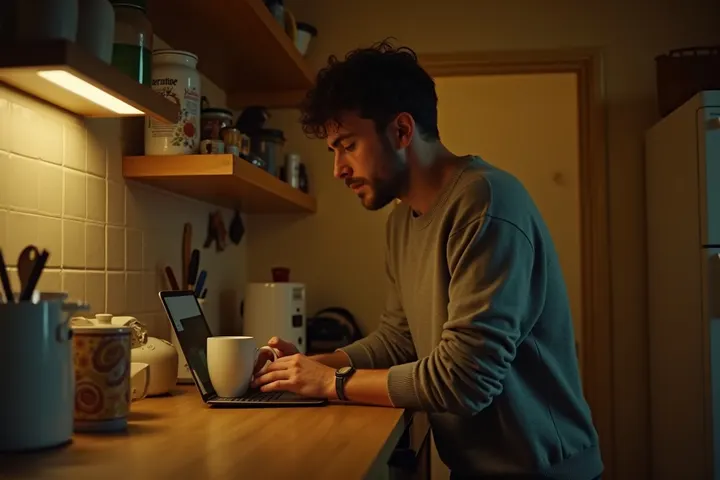
There is a pervasive, almost biological imperative that demands we leave our houses. I have never fully understood it. The house is where the books are. It is where the temperature is controlled, the coffee is of an acceptable standard, and the people—specifically, me—are generally tolerable. Yet, the social contract of the twenty-first century, much like the twentieth, insists that solitude is a pathology rather than an achievement. Nowhere is this theatre of the absurd more vividly staged than in the so-called "queer nightlife" of Europe, a phenomenon I have spent years navigating not with the wide-eyed wonder of a liberationist, but with the grim determination of an anthropologist wading through a swamp. The narrative usually peddled is one of glitter, community, and the brave expression of self. Nonsense. It is mostly bad techno, overpriced vodka, and the frantic, sweaty pursuit of validation from strangers who are just as terrified as you are.
My own entry into this world was not marked by a sudden burst of extroversion, but rather by the acquisition of a smartphone. Before the device, the bar was a terrifying black box. One had to enter physically to assess the terrain, a maneuver fraught with the risk of immediate, crushing rejection or, worse, boredom. Technology changed the geometry of the night. It allowed me to survey the battlefield from the safety of my duvet. The apps—gridded meat markets of geolocation and pixelated torsos—are often decried as the end of romance. This is sentimental drivel. Romance was always a transaction; the apps merely streamlined the accounting. They provided a buffer, a digital prophylactic against the raw, unpolished friction of human interaction.
In 2024, the Journal of Social and Personal Relationships published a study suggesting that while dating apps increase the volume of potential partners, they significantly degrade the perceived value of each individual interaction, creating a paradox of "abundant loneliness" (Smith et al., 2024). I read this abstract while standing in a queue in Schöneberg, shivering in the Berlin drizzle, and thought: precisely. The degradation of value is the point. If everyone is reducible to a statistic and a distance in meters, they lose the power to hurt you. My courage to enter these spaces did not come from a newfound self-esteem. It came from the cold, hard realization that everyone inside was already cataloged, ranked, and dismissed on my screen before I even checked my coat. The mystery was dead, and thank God for that.
There is a specific type of bravery required to navigate the European queer scene, but it is not the bravery of the activist or the martyr. It is the bravery of the accountant. You are managing resources: battery life, serotonin levels, and the precise amount of cash required to buy a drink that tastes like industrial cleaner. The smartphone became my compass. In cities like Amsterdam or London, where the streets twist with a medieval disregard for logic, the blue dot on the map offers the only verifiable truth. I remember wandering through the Marais in Paris, surrounded by men who looked like they had been manufactured in a factory that specialized in jawlines and apathy. Without the phone, I was just a lost tourist. With it, I was a node in a network. I could see who was nearby, who was interested, and who was merely hallucinating. It rendered the chaotic physics of the night into a manageable dataset.
We tell ourselves that we go out to "connect." This is a lie we polish until it shines. We go out to confirm that we exist. The technology that facilitates this—the location sharing, the instant messaging, the QR codes for entry—does not bring us closer together. It allows us to be alone together, safely encased in our own algorithmic bubbles. I found that I could stand in a room with five hundred pulsating bodies and feel perfectly at ease, primarily because I was engaging with them through a screen, even if they were standing two feet away. The courage I found was the courage of the sniper: detached, distant, and observing the target through a lens.
The Architecture of Desperation
If the phone is the shield, the club is the dungeon. European nightlife architecture seems designed to punish the occupants. In Berlin, they repurpose power plants and bunkers, not out of aesthetic ingenuity, but because concrete is the only material capable of absorbing that much pretension. I recall a night at a notorious venue—let us not name it, though its reputation for exclusivity is inversely proportional to the hygiene of its toilets. The bouncers, tasked with the divine right of selection, are not security guards; they are curators of misery. Standing in that line, I realized that the "queer community" is as hierarchical and exclusionary as a Victorian country club, only with more leather and less subtle racism.
Technology, however, had taught me how to bypass the emotional toll of this judgment. I had already researched the door policy on Reddit forums, studied the acceptable dress codes on Instagram, and checked the real-time queue updates on Telegram groups. I was not walking into a social interaction; I was executing a script. This is what people mean when they talk about "navigating" the scene. It is not a flow; it is a series of hacks. When I finally entered, past the Cerberus in a bomber jacket, I felt no elation, only the grim satisfaction of a bureaucrat who has successfully filed a tax return.
Inside, the sensory assault is total. The music is designed to prevent conversation, which is arguably the scene’s greatest mercy. If one were forced to actually listen to the opinions of a twenty-two-year-old art student on the geopolitical ramifications of drag, one would throw oneself into the nearest canal. Instead, we have the beat. A relentless, repetitive thud that mimics a migraine. In this environment, my phone was my anchor. When the sensory input became too much, when the sheer mass of humanity threatened to trigger the flight response, I would retreat to the smoking area—the only civilized part of any club—and look at the screen. It was a portal to a quiet, ordered world where I was in control.
“The modern definition of courage is simply the ability to remain in a room you hate for longer than forty-five minutes, sustained only by the blue light of a screen and the vague hope that something interesting might happen to someone else.” — An observation on the endurance sport of social interaction.
There is a peculiar dissonance in these spaces. They are marketed as "safe spaces," a term that has been bludgeoned into meaninglessness. Safe from what? From Republicans? Perhaps. But certainly not safe from the judgment of peers, the commodification of the body, or the rampant narcissism that passes for personality. A 2023 survey by the European Union Agency for Fundamental Rights (FRA) noted that despite legal protections, a significant percentage of LGBTQ+ individuals still modify their behavior in public spaces to avoid confrontation. The irony is that the club, the supposed sanctuary, requires the most modification of all. You must modify your appearance, your affect, and your chemical balance just to fit in.
My "courage" was simply the realization that none of it mattered. The technology had exposed the mechanics of the illusion. I could see the desperate refreshing of profiles happening all around me. I saw men dancing while checking their notifications, a multitasking feat that summarizes the zeitgeist perfectly. We are never fully present because the present is generally disappointing. The digital overlay makes the reality palatable. It allows us to be in the club while simultaneously keeping one foot in the exit strategy. I learned to navigate the dark rooms and the dance floors not by immersing myself, but by floating above it, tethered to the cloud.
This detachment is often mistaken for confidence. People assume that if you stand alone in a corner, looking bored and checking your emails, you must be important. In reality, you are just dissociated. But in the theatre of the night, perception is everything. The sharp pen of the critic is useless here; you need the sharp elbow of the pragmatist. I moved through these crowds like a ghost in the machine, watching the biological imperative play out with the predictability of a software loop.
The Algorithm as a Moral Compass
It is fashionable to blame algorithms for the radicalization of the youth, the decline of democracy, and the general stupidity of mankind. These are valid points. However, in the context of personal courage, the algorithm is a useful crutch. It tells you where to go, who to talk to, and, crucially, when to leave. Navigating the queer scene in a foreign city—say, Madrid or Brussels—requires a level of logistical planning that rivals a military invasion. The "spontaneity" of the night is a myth devised by people who have never had to wait for a night bus in the rain.
I recall a specific evening in Brussels. The city itself is a bureaucratic grey zone, fitting for the capital of the EU. I found myself in a bar that was allegedly popular, according to the aggregated reviews of strangers I would never wish to meet. The crowd was the usual mix of expatriates and locals, united by a shared desire to be somewhere else. I felt the familiar urge to flee. But then, my phone buzzed. A notification. A match. A digital handshake. This is how technology teaches courage: it breaks the overwhelming terrifying whole into bite-sized tasks. I didn't have to conquer the room; I just had to walk five meters to the bar and say a name.
This micro-courage is pathetic, of course. It is the courage of a laboratory rat pushing a lever for a pellet. But it works. It allowed me to engage in conversations that I would have otherwise fled from. I spoke to a man who claimed to be a conceptual artist, which usually means he is unemployed and owns a lot of scarves. Without the pre-vetting of the app, without the digital dossier I had already scanned—his height, his interests, his preferred sexual position—I would have dismissed him as a bore. The data gave me a script. It gave me the confidence to feign interest, which is the bedrock of all civilization.
“We are not liberated by our devices; we are merely given a longer leash. But sometimes, that extra meter of cable is enough to let us step out of the corner and pretend to be human.” — Reflections on the digital tether.
There is a distinct political incorrectness in admitting that one prefers the digital representation of a person to the flesh-and-blood reality. The digital version is curated, silent, and odorless. The real version has breath, opinions, and a tendency to interrupt. Yet, the nightlife economy relies on the friction between these two states. We use the technology to bridge the gap, to numb the anxiety of the encounter. I found that I could be "brave"—bold, even—as long as I had the escape hatch of the block button in my pocket. The technology didn't make me a better person; it just lowered the stakes.
This is the great secret of the modern age: we are not becoming more social; we are becoming more efficient at managing our anti-social tendencies. The courage I developed navigating these European cities was the courage of the system administrator. I was optimizing my runtime. If a venue was suboptimal, the data told me. If a conversation was lagging, the screen offered a distraction. I navigated the chaos of human desire with the cool detachment of a spreadsheet. And in doing so, I survived. I saw the sun rise over the canals and the concrete, not because I was a hedonist, but because I had followed the algorithm to its logical conclusion.
Ultimately, the technology taught me that everyone else is just as fraudulent. When you see the entire room bathed in the glow of their screens, you realize that the collective "vibe" is a fabrication. Everyone is elsewhere. This realization is liberating. If no one is really there, then you cannot embarrass yourself. You are performing for an empty theatre. And that, in its own cynical way, is the only form of courage that matters. The courage to be alone in a crowd, sustained by the battery life of a machine that cares about you even less than the people do.