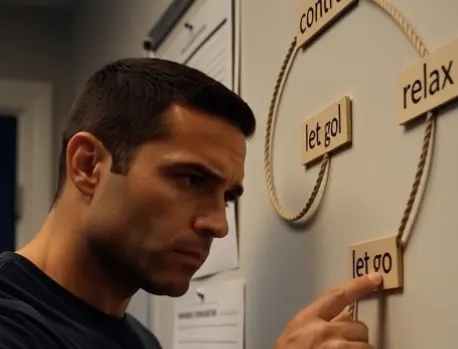
The Couch, The Cage, and The Coping Mechanism
There is a prevailing obsession in the twenty-first century with the concept of "healing." We are a civilization of broken pottery, endlessly trying to glue ourselves back together with yoga, mindfulness apps, pharmaceuticals, and the paid sympathy of strangers with degrees on their walls. In this marketplace of sanity, where every neurosis has a corresponding billing code, the idea that a whip might accomplish what a cognitive behavioral worksheet cannot is met with the sort of horrified gasps usually reserved for a confession of murder. The general public, viewing the world through the sanitized lens of a daytime talk show, views BDSM as the cause of trauma, never the salve. They see the bruise and assume a victim. They see the cage and assume a prisoner. They lack the imagination to conceive that for some, the cage is the only place where they truly feel free.
The phrase "Kink is my therapy" is tossed around the dungeon circuit with the casual frequency of a greeting. It is a controversial statement, hated by actual therapists who worry about liability, and mocked by the vanilla majority who think "therapy" implies talking about your mother while sitting in a beige room. However, the mechanism is strikingly similar. Both traditional therapy and a BDSM scene involve a negotiated power exchange, a safe container, and the dredging up of the subconscious. The difference is merely one of methodology. One uses words to circle the drain of the psyche; the other uses sensation to punch through the blockage directly.
A 2023 study published in the Journal of Clinical Psychology investigated the motivations of BDSM practitioners and found that a significant subset reported "therapeutic benefits," including stress reduction, trauma processing, and improved emotional regulation (Lindemann & Klement, 2023). The scientific community is slowly, grudgingly admitting that perhaps the freaks are onto something. Yet, the social stigma remains immovable. The idea that one can find peace through pain, or control through submission, offends the modern sensibility, which views all pain as an error to be corrected and all submission as a political failure. We are told we must be happy, autonomous, and pain-free at all costs. The BDSM practitioner looks at this mandate and politely declines, preferring the honest agony of the cane to the dull ache of existential dread.
Whether BDSM "works" as therapy in a clinical sense is a debate for academics who have never felt the rush of endorphins that follows a heavy scene. It is a moot point. The efficacy of a coping mechanism is subjective. If a man finds that being treated like a piece of furniture for an hour allows him to function as a CEO for the rest of the week, who are we to tell him he is doing it wrong? The critics argue that this is "maladaptive." I would argue that in a world that is fundamentally insane, any adaptation that keeps you alive and out of prison is a victory.
The Arrogance of the "Healthy" Mind
The judgment cast upon those who use kink as a balm is rooted in a profound arrogance. It is the arrogance of the "normal," the belief that there is a standard template for human happiness and that any deviation from it is a pathology. The critic looks at a submissive surrendering control and sees "low self-esteem." They look at a masochist enduring pain and see "self-harm." They are amateur Freudians, armed with a vocabulary they picked up from Netflix dramas, diagnosing strangers they have never met. They cannot conceive that the surrender of control might be a rational response to a life where one is forced to be in control of everything, all the time.
This judgment is particularly rich coming from a society that medicates its population into a stupor. We accept that a person might need a glass of wine to unwind, or a pill to sleep, or five hours of mindless television to numb the brain. These are "acceptable" coping mechanisms. But the moment someone suggests that high-impact sensation might achieve the same result—a silencing of the inner noise—the moral panic begins. The critic demands that our coping mechanisms be sterile. They want us to heal, but only in ways that don't frighten the horses.
There is a pervasive myth that BDSM is merely a "re-enactment of trauma." The armchair psychologist nods sagely and says, "She likes to be tied up because she felt trapped as a child." This is a reductive, insulting simplification of the human machine. While it is true that some survivors of trauma find agency in controlling the scenario of their victimization—a process known as "scripting"—for many others, the kink has absolutely nothing to do with their past. It is simply a biological preference, like a taste for spicy food. To insist that every kink must have a tragic origin story is to deny the complexity of desire. It reduces the practitioner to a broken object that needs fixing, rather than a complex subject who has found a unique way to play.
“Society forgives the alcoholic sooner than the masochist. The alcoholic is destroying himself in a way we understand—through consumption. The masochist is destroying the illusion of the civilized self, and that is a heresy we cannot abide.” — On the hierarchy of acceptable vices.
The critics also fail to understand the concept of "aftercare," a pillar of the BDSM community that the vanilla world would do well to emulate. In a scene, the infliction of intensity is followed by a period of nurturing, reassurance, and care. In the "real" world, we inflict trauma on each other constantly—in boardrooms, in comments sections, in families—and then we walk away. We offer no aftercare. We just leave the wounds open. The BDSM community, for all its scary aesthetics, is often more emotionally responsible than the society that judges it. They break you, yes, but they put you back together. The world just breaks you.
The Chemistry of the Reset Button
Let us step away from the psychological projection and look at the biology. The brain is a chemical factory. When the body is subjected to intense sensation—pain, fear, restriction—the factory goes into overdrive. It pumps out endorphins, enkephalins, and adrenaline. It induces a state of altered consciousness often referred to as "subspace" or "flying." This is not a mystical experience; it is a physiological one. It is a natural high. To condemn someone for seeking this state through ropes and paddles is no different than condemning a runner for seeking a "runner's high." It is just a different route up the same mountain.
For those with busy, anxious, or hyper-vigilant minds, this chemical flood acts as a hard reset. It is a "Blue Screen of Death" for the ego. In the throes of a heavy scene, you cannot worry about your mortgage. You cannot worry about your emails. You are reduced to a singular point of existence: I am here, and this hurts, and I am flying. This radical presence is what mindfulness gurus charge thousands of dollars to teach in retreats. The kinky get it for the price of a flogger.
A 2024 meta-analysis in Frontiers in Psychology examined the concept of "flow" in BDSM activities, comparing it to the flow states achieved by elite athletes and musicians (Dunkley et al., 2024). The study concluded that the "transient hypofrontality" (the shutting down of the prefrontal cortex) experienced during a scene allows for a profound release of self-consciousness. If we accept that "therapy" is anything that helps us process emotion and reduce suffering, then this biological mechanism certainly qualifies. It is a chemical vacation from the burden of being oneself.
The critic asks, "But does it cure the underlying issue?" This is the wrong question. Does Prozac cure the underlying issue? Does talking about your childhood for ten years cure the underlying issue? Or do these things simply make the day-to-day bearable? We put too much pressure on the idea of a "cure." Perhaps there is no cure for the human condition. Perhaps there is only management. And if a person manages their existential despair by engaging in consensual power exchange, it is arguably a more active and engaged form of management than staring at a wall.
The Sovereign Right to Choose Your Poison
Ultimately, the debate about whether BDSM "is" therapy is a semantic trap. It matters little whether the American Psychological Association puts a stamp of approval on it. What matters is the autonomy of the individual. We live in an era where our choices are increasingly narrowed by algorithms, bureaucracies, and social pressure. The right to do with one's body as one pleases—provided it does not harm the non-consenting—is the fundamental unit of liberty. If I choose to process my grief, my rage, or my boredom by engaging in a ritual of dominance and submission, that is a sovereign act.
The rush to judge is a rush to control. The normative majority wants to colonize the outliers. They want to bring the freaks back into the fold, to clean them up, to make them "healthy" according to a definition of health that looks suspiciously like compliance. But there is a dignity in the refusal to be healthy in the way they demand. There is a dignity in saying, "My mind works differently, and I have found a tool that fits the shape of my madness."
We should be wary of anyone who claims to know what is best for another person's psyche. The human mind is a terrifying labyrinth. Some people navigate it with a map and a flashlight; others navigate it by feeling the walls in the dark. To claim that the former is superior to the latter is just administrative vanity.
“We are all self-medicating against the tragedy of consciousness. Some use religion, some use commerce, and some use a well-timed impact. To sneer at the latter while indulging in the former is the height of hypocrisy.” — Reflections on the universal need for relief.
So, let the critics clutch their pearls. Let them write their concern-trolling articles about the dangers of the lifestyle. Meanwhile, in basements and bedrooms across the world, people will continue to find relief in the snap of the rope and the silence of the hood. They are not asking for approval. They are not asking for a diagnosis. They are simply asking to be left alone to practice their own strange, jagged form of healing. And in a world that seems bent on driving us all mad, that seems like a perfectly reasonable request.