The Aristocracy of the Unfinished Symphony
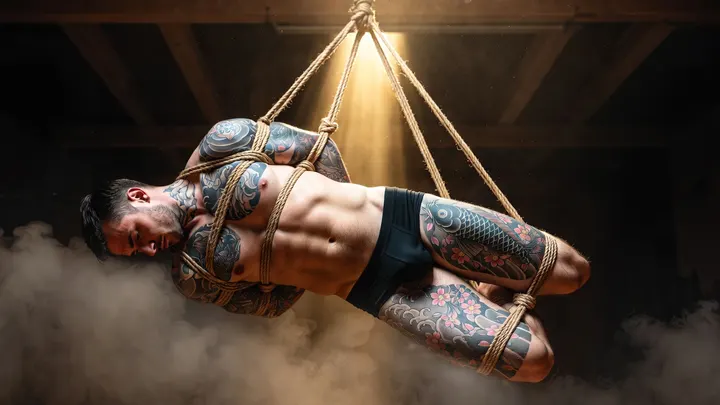
There is a pervasive, almost pathological belief in the modern world that every activity must have a "deliverable." We go to the gym to get muscles; we read books to become "smarter" (a dubious proposition given the bestseller lists); and we engage in sexual activity to achieve the orgasm. This final spasms is viewed as the receipt for the transaction, the proof that the time was not wasted. Consequently, when the dull, vanilla majority peers over the fence at the practitioners of non-sexual kink—the rope artists, the impact players, the sensory deprivation enthusiasts who seek no genital release—they recoil in confusion. "What is the point?" they ask, their brows furrowed with the strain of trying to understand a narrative that doesn't end with a biological sneeze. They view kink without sex as a sentence without a period, a joke without a punchline, or a dinner consisting entirely of appetizers.
This confusion reveals less about the "aberrant" nature of the kinky and more about the tragic lack of imagination in the critic. The critic lives in a world of teleology, where the end justifies the means. They are the tourists who sprint through the Louvre to see the Mona Lisa just so they can say they saw it, ignoring the miles of canvas in between. To them, kink without sex is "incomplete." To the connoisseur, it is the only form of play that is truly pure, precisely because it refuses to bow to the tyranny of the biological imperative. It is the difference between drinking wine to get drunk and drinking wine to taste the grapes. The former is a function; the latter is an art.
The judgment cast upon these practitioners is rooted in a deep-seated fear of the pointless. In a capitalist society, everything must be productive. Even our leisure must be "restorative" so we can return to the factory. Sex is permitted because it produces children or relieves stress, both of which serve the economy. But to tie someone up for three hours, to trace the lines of their nervous system with a feather or a flogger, solely for the exchange of sensation and power, with no "productive" release at the end? That is heresy. It is a waste of time. And to the modern mind, wasting time is the ultimate sin. The practitioner of non-sexual kink is, in this light, a radical decadent, luxuriating in the moment rather than rushing toward the exit.
A 2023 study published in the Journal of Sexual Medicine explored the motivations of "high-frequency BDSM practitioners" and found that a significant cluster of participants prioritized "alterity" (altered states of consciousness) and "flow states" over sexual gratification (Simmons & Hart, 2023). The researchers, likely baffled, had to code this as "non-genital focused gratification." The science is slowly catching up to what the dungeon masters have known for decades: the brain is the largest sexual organ, and it does not necessarily need the genitals to have a good time. In fact, the genitals are often a distraction, a noisy neighbor banging on the wall while the brain is trying to compose a symphony of endorphins.
The critics who label this practice as "incomplete" are exposing their own limitations. They are admitting that they cannot sustain intimacy without the crutch of friction. They are admitting that they cannot look at a partner, or feel a partner, without immediately needing to turn that connection into a hydraulic process. They are the ones who are incomplete. They are missing the vast, terrifying, and beautiful landscape of human sensation that exists before, after, and entirely separate from the climax. They are eating the menu and thinking they have tasted the meal.
The Neurochemistry of the Ascetic
Let us dismantle the biology of this judgment. The average person believes that "sex" is a specific sequence of events triggered by libido and resolved by dopamine. When they see someone engaging in "impact play"—the rhythmic application of sensation, often intense, to the skin—without the intent of sexual release, they assume it is merely violence or repressed frustration. They are wrong. It is chemistry. The practitioner of non-sexual kink is essentially a self-medicating pharmacist. They are engineering a specific cocktail of neurotransmitters—endorphins, oxytocin, adrenaline, and endocannabinoids—that produces a high often described as "subspace" or "flying."
To the uninitiated, pain is a warning signal. To the practitioner, pain (or intense sensation) is a key that unlocks the pharmacy. When the body is subjected to controlled stress—be it the restriction of rope or the sting of a cane—the brain panics, delightfully. It floods the system with natural painkillers. This state is not sexual in the traditional sense; it is transcendental. It is closer to the runner’s high or the clarity of deep meditation than it is to the fumbling groping of a Friday night hookup. The "judge" who sneers at this is comparable to a drunk mocking a monk. One is seeking oblivion; the other is seeking clarity.
The absence of sexual release is crucial to this state. The orgasm, for all its popularity, is a sedative. It is the "little death" that ends the tension. By denying the orgasm, by removing sex from the table, the practitioner prolongs the high. They exist in a state of suspended animation, riding the wave of chemicals without crashing into the shore. It requires a discipline that the average person lacks. It requires the ability to sit with intensity without trying to "fix" it or "finish" it.
“The orgasm is the bourgeois conclusion to the narrative of desire. It ties everything up in a neat little bow and says, ‘The show is over, go to sleep.’ The refusal of the orgasm is the refusal of the ending. It is the decision to live in the tension, which is where all the art happens.” — On the aesthetic superiority of denial.
Recent psychological literature supports the distinct nature of this experience. A paper in Frontiers in Psychology (2024) distinguished between "sexual flow" and "pain-induced flow" in BDSM contexts, noting that the latter often leads to deeper feelings of bonding and "self-dissolution" (van der Kolk et al., 2024). The "self-dissolution" is key. In non-sexual kink, the ego dissolves. You are no longer a tax accountant; you are merely a vessel of sensation. In standard sex, the ego is often painfully present ("Do I look fat?", "Am I doing this right?", "Did I leave the oven on?"). The "incomplete" act is, in fact, the more complete escape from the self.
The critics see a lack of sex and call it "repression." This is a Freudian error. Repression is the unconscious blocking of desire. This is the conscious redirection of desire. It is sublimation in real-time. The energy that would normally be wasted on a fleeting moment of genital contraction is instead channeled into a sustained state of hyper-awareness. It is not less than sex; it is more than sex. It is sex distilled to its essence—connection and intensity—without the messy biological cleanup.
The Intimacy of the Scalpel
There is a widespread delusion that intimacy requires nudity and friction. This is the "romance novel" model of human connection, and it is laughably simplistic. Most people have had sex that was about as intimate as a handshake. You can have sex with someone you despise. You can have sex with someone you don't know. But to let someone tie you up? To let someone control your breathing? To let someone suspend you from the ceiling? That requires a level of trust that makes the average marriage vow look like a casual suggestion.
Non-sexual kink strips away the performance of sex. In a sexual encounter, there is a script. You moan here, you move there, you feign pleasure to spare feelings. In a non-sexual kink scene, the script is burned. The focus is entirely on the reality of the moment. If the rope is too tight, you say so. If the impact is too hard, you stop. The communication is absolute. There is no room for the polite fictions of the bedroom. This "radical honesty" is terrifying to the vanilla critic, who relies on social lubricant and ambiguity to navigate their relationships.
The "judge" looks at a scene—say, a person in a sensory deprivation hood being fed fruit by a partner—and sees a freak show. What they are actually seeing is care. They are seeing attention. In a world where most people look at their phones while their partners are talking, the total, undivided attention of the Dom/sub dynamic is a rare commodity. It is intimacy performed with a scalpel. It is precise, dangerous, and incredibly focused. The sex act, by comparison, is often a blunt instrument.
Furthermore, removing the sexual expectation creates a "safe container" for exploration. A 2022 study in the Archives of Sexual Behavior found that individuals with trauma histories often prefer non-sexual kink because it allows them to experience touch and intensity without the "threat" of sexual demand (Levine & Roberts, 2022). It decouples intensity from predation. The critics who mock this as "kink-lite" or "tourism" are failing to understand that for many, this is the healing. It is the retraining of the nervous system to accept touch as a gift rather than a transaction.
“To judge kink without sex is to judge a conversation because it didn't end in an argument. Sometimes, the exchange is the point. Sometimes, the silence between the notes is louder than the crescendo.” — On the misunderstanding of quiet intensity.
The intimacy of the non-sexual scene is the intimacy of the trenches. You endure something together. You navigate a high-stakes environment together. When it is over, you share a specific type of exhausted silence that is far more profound than the post-coital cigarette. The critics are likely jealous. They look at their own lives—the rote, scheduled intimacies, the birthday sex, the anniversary card—and they sense, dimly, that they are missing out on the raw material of human connection. They judge because they are bored.
The Rebellion Against Utility
Ultimately, the practice of kink without sex is a philosophical stance. It is a rebellion against the utility of the body. We are told that our bodies are tools. They are for working, for breeding, for consuming. To use the body for something that produces nothing—no baby, no orgasm, no profit—is a deeply subversive act. It is art for art's sake.
The critics are the accountants of the soul. They want the balance sheet to line up. "Input: Stimulation. Output: Orgasm." When the equation fails, they get anxious. They call it "blue balls" or "frustration." They cannot conceive of a pleasure that does not involve emptying the tank. But the practitioner knows that the tank does not need to be emptied; it needs to be expanded. They are expanding their capacity for feeling.
So, is it incomplete? Only if you think a song is incomplete because it doesn't end with a crash of cymbals. Only if you think a journey is incomplete because you didn't buy a souvenir at the end. The people practicing this are not "missing" the sex. They have transcended the need for it to validate their experience. They have found a way to be fully alive, fully present, and fully connected, without needing to perform the biological handshake that the rest of the world relies on to prove they exist.
To the judges, I say this: Your confusion is not a sign of your moral superiority. It is a sign of your sensory poverty. You are eating Wonder Bread and laughing at people who are fermenting their own sourdough. They are working harder, yes. It takes more time, yes. But the flavor? The flavor is something you will never understand as long as you keep rushing to the finish line.