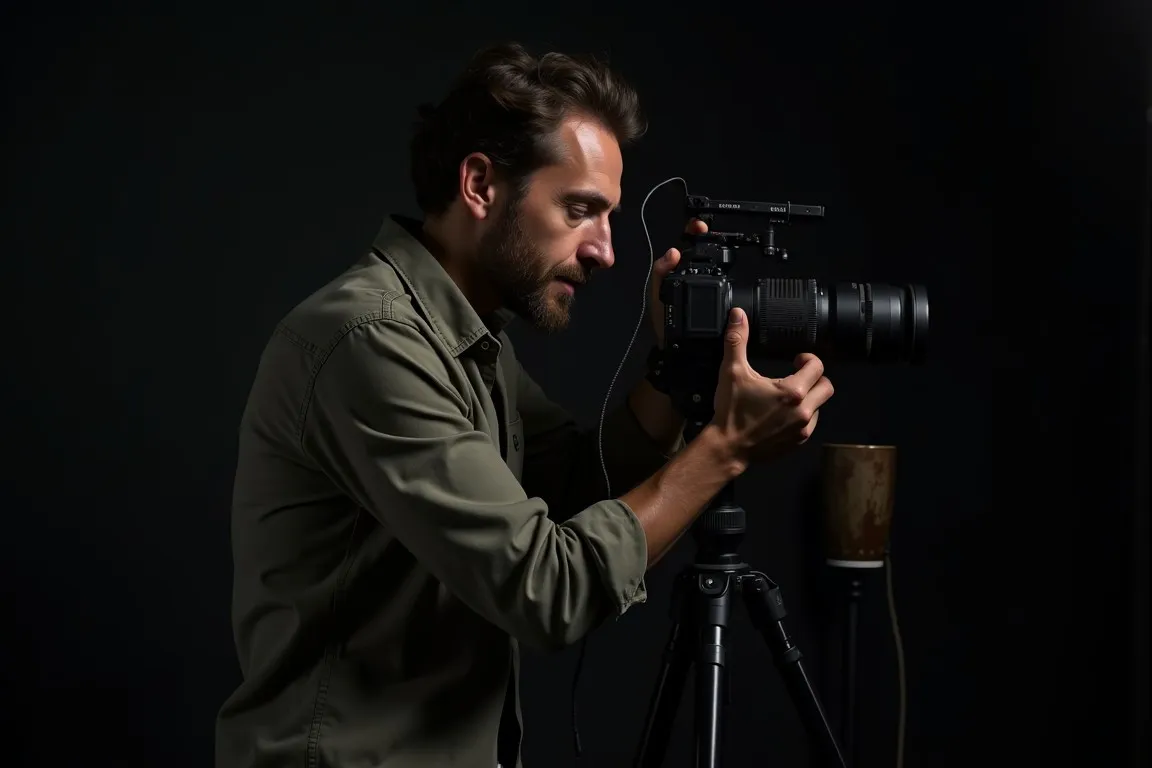
He stands behind the tripod, a three-legged altar to the god of optics, and waits. The room is quiet, save for the humming of the strobe lights which are currently costing more per hour than the dignity of the person tied to the chair. He understands, with the weary clarity of a man who has seen too much, why Vermeer took so long to paint a milkmaid. It was not, as the art historians romanticize, a pursuit of divine perfection. It was a neurotic inability to accept that reality is inherently messy. The rope is too tight, biting into the flesh like a bad conscience. Then it is too loose, suggesting a lack of commitment. He adjusts the knot. He adjusts the light. He is chasing a ghost—that split second where the subject forgets they are an accountant from Dusseldorf and becomes a tragic figure of sublime suffering.
Photography, he has long concluded, is not an art. It is a theft. It is the act of stealing a moment that was never meant to be frozen and pinning it to a digital board like a dead butterfly. In the realm of fetish, this theft is aggravated burglary. He hovers between the role of the artist and the role of the accomplice. Every frame he captures is a secret betrayed. Too much light, and the magic evaporates, leaving only the clinical reality of skin and hemp. Too little light, and it descends into the murky aesthetic of cheap pornography. He wipes the lens, not because it is dirty, but because his own pulse seems to be fogging the glass. Everyone wants to look at desire; absolutely no one wants to be caught looking.
Susan Sontag, in her seminal work On Photography (1977), argued that "to photograph people is to violate them," by seeing them as they never see themselves, by having knowledge of them that they can never have. He thinks of this often as he stares through the viewfinder at a woman who is currently suspended three feet off the ground. She consented, yes. She signed the waiver. But does she understand that he is about to turn her vulnerability into a jpeg? The camera is a weapon that fires at 1/200th of a second. He presses the trigger, and the violation is complete. He tells himself he is documenting courage. In his darker moments, he knows he is merely a voyeur with better equipment.
The dilemma is structural. The fetish photographer is tasked with capturing the "authentic" moment of submission or dominance. But the moment a camera is introduced, authenticity flees the room. The subject is performing. He is performing. The rope is performing. They are all actors in a silent play titled "The forbidden," performing for an audience of one sensor chip. He adjusts the aperture, trying to blur the background, trying to blur the lie.
The Geography of the Basement
There is a specific, depressing geography to the fetish studio. It must strike a balance that is architecturally impossible. It must be private enough for the subjects to shed the heavy, grey armor of their daily lives—the suits, the mortgages, the fear of their mothers—but professional enough that they do not feel they have stumbled into the lair of a serial killer. He has curated this space carefully. The walls are black, naturally. The equipment is industrial. It is designed to signal "Art," not "Evidence."
He watches the subjects enter. He has learned to read the physiology of shame. They arrive carrying their tension like a second skeleton, rigid and brittle. They make small talk about the traffic, about the weather, desperate to maintain the facade of normalcy while holding a bag full of latex hoods. It is a comedy of manners played out on the edge of a precipice. He nods, he offers water, he plays the role of the neutral technician. But he is waiting for the shift.
It happens usually ten minutes into the session. The shoulders drop. The face changes. It is not a dramatic transformation—life is rarely a movie—but a subtle slackening. The mask of the "good citizen" slips, revealing the raw, hungry thing underneath. A 2021 study in Psychology of Consciousness describes the "flow state" in BDSM practitioners as a form of transient hypofrontality—essentially, the part of the brain that worries about taxes and social judgment shuts down (Wuyts et al., 2021). He waits for this brain-death of the ego. Before that moment, he is photographing a costume party. After that moment, he is photographing a soul. And that is where the danger lies.
“The camera does not distinguish between a moment of transcendental surrender and a moment of humiliating vulnerability. It records both with the same indifference. It is the photographer’s job to impose a moral narrative on a machine that has none.” — Reflections on the apathy of the lens.
The difference is measured in seconds. If he shoots too early, the subject looks ridiculous—a grown adult in a harness looking confused. If he shoots too late, he feels like a predator picking at a carcass. He must capture the instant where the armor is gone but the dignity remains. It is a tightrope walk over a pit of absurdity. He is the curator of their shadow selves. He captures the part of them that only exists in the dark, and by capturing it, he drags it into the light. It is a paradox: to preserve the secret, he must expose it.
The Lie of the Light
Technical discussions about fetish photography always devolve into arguments about lighting, but he knows this is a distraction. They are arguing about philosophy, they just don't have the vocabulary for it. The choice of light is a moral choice. Harsh light—the strobe, the flash—is the light of the interrogation room. It reveals everything. The pores, the stretch marks, the slight asymmetry of the knot, the panic in the eyes. It is honest to the point of brutality. Some photographers prefer this; they call it "raw." He calls it cruel. It strips away the mystery that makes the image erotic and leaves only the meat.
Soft light, on the other hand, is the light of the romance novel. It conceals. It smoothes over the rough edges of reality. It creates "atmosphere," which is a polite word for "obscurity." But too much softness and the image becomes sentimental. It becomes "pretty." And there is nothing worse in fetish than prettiness. Prettiness is for wedding photographers and advertisements for yogurt. Fetish requires a certain grime, a certain darkness.
He seeks the middle ground, the "productive tension." The image must suggest more than it shows. It must invite the viewer to complete the picture with their own filthy imagination. This is the difference between art and pornography. Pornography is the tyranny of the explicit; it leaves no room for the mind. Art thrives on the missing information. He places a shadow across the face, hiding the identity but revealing the mouth. He highlights the tension in the hand but obscures the reason for it. He is a censor who calls himself an artist.
He frames the shot. A rope bisects a torso. In the viewfinder, it is a study in geometry and texture. In reality, it is a person who will have to go back to work on Monday and explain the bruises. He focuses on the texture of the rope, ignoring the humanity of the skin. It is easier that way. If he thinks too much about the person—the lawyer, the teacher, the parent—his hand shakes. He must reduce them to form and shadow. He must dehumanize them to make them beautiful. This is the photographer’s pact: he trades their humanity for an aesthetic object.
The Ethics of the Peep Show
There is a moment in every session where the power dynamic becomes so palpable it almost has a smell. He is clothed; they are naked. He is standing; they are bound. He holds the device that creates history; they are the subject of it. The asymmetry is absolute. The photographer who claims to be a "neutral observer" is a liar or a fool. There is no neutrality here. He is a voyeur with a permit. He is profiting—socially, artistically, perhaps financially—from their vulnerability.
He goes through the motions of ethics. He checks in. "Are you okay?" "Do you need water?" "Can we continue?" These are necessary rituals, the safety instructions on the airplane before it crashes. He creates space for them to say no, to reclaim the agency that the camera strips away. But he knows, deep down, that the pressure to perform is immense. Once the lights are on, once the camera is raised, the subject feels the weight of the "shoot." They want to be good subjects. They want to give him the shot. The consent is there, but it is coerced by the momentum of the art.
And what remains? A digital file. A collection of pixels that proves this person, this respectable member of society, has a shadow. A photograph of rope bondage is never just a photograph of rope bondage. It is evidence. It is blackmail material waiting to happen. He thinks about this as he backs up his hard drive. He is holding the reputations of dozens of people in a small metal box. They trust him. Why? Because he has a website? Because he speaks in a calm voice? It is a terrifying amount of trust to place in a man whose primary skill is knowing where to put a light stand.
“We are archiving the temporary insanity of the human animal. We take the fleeting, sweaty, desperate desire to be used, and we turn it into a static image that will last longer than the desire, longer than the relationship, and certainly longer than the body itself.” — On the permanence of the fleeting.
Ultimately, he realizes that he is not capturing desire. Desire is unphotographable; it is a chemical reaction, a phantom. He is documenting the courage to be desiring. He is documenting the defiance of a person who says, "I am this thing, and I will let you see it." The photograph is a tombstone for that moment of bravery. It is a collaboration between his cynicism and their hope.
The shutter closes. The flash fires, blinding them both for a millisecond. In that blindness, the transaction is sealed. He has his image. They have their experience. And somewhere in the gap between the two, the truth has been lost, replaced by a beautiful, well-lit lie. He checks the histogram. It’s a good exposure. He feels nothing but the satisfaction of a job well done, and the vague, lingering sense that he should probably apologize to someone, though he isn't sure who.