The Sterile Utopia of the Chatbot Lover
We are standing on the precipice of a great and terrible convenience. The techno-evangelists, those shrill prophets of Silicon Valley who wear hoodies instead of hairshirts, promise us that the future of human intimacy is digital. They tell us that Artificial Intelligence will solve the messy, inefficient, and often humid problem of human desire. Why leave the house to navigate the treacherous social geography of a fetish bar when you can strap on a headset, chat with a Large Language Model that has been trained on fifty years of erotic literature, and generate a partner who never gets tired, never smells of garlic, and never judges your request to be treated like a piece of office furniture?
It is a compelling pitch for the agoraphobic and the pathologically narcissist. The AI lover is the ultimate mirror. It reflects your desires back to you with perfect fidelity, stripped of the friction that defines reality. But this frictionlessness is precisely the problem. We are building a padded cell of gratification. The fetish bar, with all its inherent discomforts—the sticky floors, the unpredictable aggressive energy, the risk of total rejection—is the only thing standing between us and the terminal boredom of getting exactly what we want, exactly when we want it.
A 2024 study published in Scientific Reports analyzed the degradation of social skills in heavy users of AI companionship apps, noting a phenomenon termed "social atrophy," where the brain loses the capacity to interpret non-verbal cues and manage the frustration of disagreement (Miller & Chen, 2024). We are training ourselves to interact with entities that have no agency, no boundaries, and no body. The AI does not flinch when you hit it. It does not look at you with genuine contempt—only a simulated approximation of it. The fetish bar is necessary because it is the last place where you can be looked at with real, biological contempt. And for the true masochist, a simulated sneer is about as satisfying as a non-alcoholic vodka.
The allure of AI is the allure of the "Undo" button. In the digital realm, every mistake can be erased. Every awkward sentence can be retyped. The fetish bar offers no such mercy. If you approach a Dom in a leather bar and say something profoundly stupid, the consequences are immediate and visceral. You are humiliated. You are ignored. You are, perhaps, physically removed. This danger is the currency of the erotic. Without the possibility of disaster, there is no thrill. We need the fetish bar because it is a theater of cruelty where the stakes are real, unlike the digital playground where we are merely avatars bumping into other avatars in a void of zeroes and ones.
The Taxonomy of Sweat
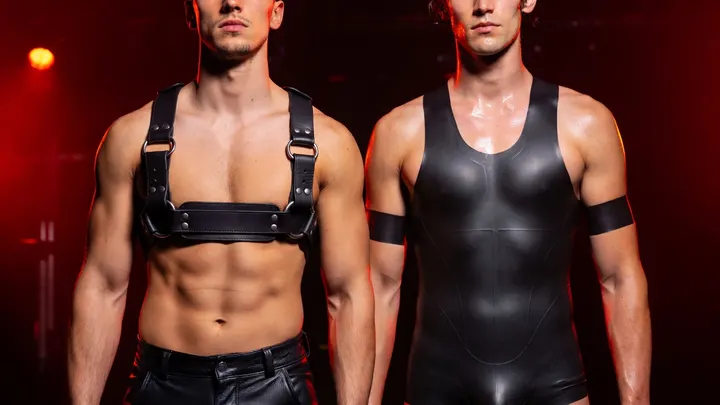
Let us discuss the sensory poverty of the machine. The current trajectory of technology is obsessed with the visual and the auditory. VR headsets offer 8K resolution; haptic suits offer buzzing vibrations that feel like a mobile phone trapped in your underwear. But they cannot replicate the smell. The fetish bar is an olfactory cathedral. It smells of leather, rubber, sweat, poppers, stale beer, and the specific, metallic tang of adrenaline. This chemical cocktail is not just atmosphere; it is information.
Biology is stubborn. We are primates who evolved to communicate through pheromones and touch, not through fiber-optic cables. When two men meet in a darkroom, there is a biological handshake that occurs long before a word is spoken. It is a compatibility check run on the hardware of the immune system. AI cannot simulate this. It can describe a smell, but it cannot make you retch or swoon. The sanitization of sex through technology removes the "grossness" of the act, and in doing so, neuters it. Sex is inherently gross. It is fluids and noises and awkward angles. The fetish bar embraces this grossness; the AI tries to clean it up.
“We are trying to upload our libido to the cloud, forgetting that the libido is an engine that runs on blood, not data. You cannot digitize the feeling of a heavy boot on your chest any more than you can digitize the taste of a steak. You can only create a picture of it, and a picture will not keep you alive.” — On the limitations of the virtual flesh.
Furthermore, the AI operates on a logic of optimization. It wants to give you the "best" experience based on your previous data points. This creates a feedback loop of sameness. If you tell the algorithm you like boots, it will give you endless boots. It will never challenge you. It will never introduce a chaotic variable. The fetish bar is an engine of serendipity. You might go in looking for a leather master and end up being captivated by a rubber pig. The bar throws you into collision with desires you didn't know you had because the algorithm hadn't predicted them yet.
A recent theoretical paper in the Journal of Digital Ethics (2023) argued that algorithmic curation of sexual content leads to a "narrowing of the erotic imagination," as users are funneled into increasingly specific micro-categories (The Silo Effect of Digital Desire, 2023). We are becoming fetishistic specialists, experts in our own narrow lanes, unable to appreciate the broad, chaotic spectrum of human perversion. The physical bar forces you to witness the other. You have to stand next to the guy into sounding while you wait for your drink. You have to acknowledge his existence. The AI allows you to filter him out.
The "haptic" technology that promises to bridge this gap is a joke. It is the equivalent of trying to play a symphony on a kazoo. The weight of a human body, the warmth of breath, the specific texture of skin—these are complex physical realities that defy digitization. We need the fetish bar because we need to be reminded that we are meat. In a world that is increasingly pushing us toward a disembodied existence as "users" or "content creators," the act of going to a bar, sweating, and engaging in physical play is a radical act of biological assertion. It is a way of saying, "I am a body, and I exist in space."
The Resistance Against Efficiency
We live in the age of the "optimized" life. We track our sleep, our calories, our steps, and now, our orgasms. AI is the ultimate tool of optimization. It promises to get you to the pleasure center of the brain via the shortest possible route. No small talk, no buying drinks, no awkward taxi ride home. Just pure, distilled dopamine. This efficiency is soulless. The fetish bar is, by design, inefficient. It is full of wasted time. You wait in line. You wait at the bar. You cruise for hours without result.
But this wasted time is not a bug; it is a feature. It is the "negative space" in which community is built. The conversation you have with the bartender while waiting for your beer is often more valuable than the sex you might have later. The shared glance with a stranger across the room builds tension. AI eliminates tension. It delivers the punchline without the setup. It gives you the climax without the foreplay.
Moreover, the fetish bar requires a social contract. You have to navigate the complex codes of the tribe. You have to learn the etiquette. You have to read the room. This social labor is what makes the experience meaningful. When you earn a nod of respect from an Elder in the scene, it means something because it was hard-won. When an AI tells you "Good boy," it means nothing. It is a script. It is a participation trophy given to you by a machine that doesn't know what a boy is.
“We are outsourcing our humanity to machines because we are too lazy to do the heavy lifting of interaction. We want the intimacy without the vulnerability. But intimacy is vulnerability. If you cannot be hurt, you cannot be held.” — On the fallacy of safe connections.
The bar is also a sanctuary from surveillance. In the digital world, every click, every chat log, every image is recorded, archived, and potentially sold. The AI knows your darkest secrets and stores them on a server in a jurisdiction you can't pronounce. The darkroom of a fetish bar has no memory. What happens there stays in the realm of the ephemeral. It is the last place where you can be truly anonymous, truly off the grid. In an age of total information awareness, the darkness of the bar is a political necessity.
We need these spaces because they are the anti-algorithm. They are chaotic, messy, smelly, and dangerous. They are the last refuge of the unpredictable. The AI will eventually be able to generate a video of your perfect partner doing exactly what you want, but it will never be able to replicate the feeling of walking into a room full of strangers and knowing that anything could happen. The machine offers probability; the bar offers possibility.
The Museum of the Primal
As we hurtle toward the singularity, or whatever dystopian techno-future awaits us, the fetish bar will take on a new role. It will become a museum of the primal. It will be the place we go to remember what we were before we merged with our phones. We will go there to touch leather that was once a cow, to smell rubber that was tapped from a tree, and to feel the sting of a cane wielded by a human hand that is capable of error.
The AI revolution is fundamentally a revolution of the mind. It seeks to liberate us from the body. But the fetishist knows that the body is not a prison to be escaped; it is the instrument to be played. The pain, the restriction, the sensory overload—these are techniques to ground us in the physical. They are anchors in reality.
So let the chatbots chat. Let the image generators hallucinate their perfect, six-fingered orgies. They can have the cloud. We will keep the basement. We will keep the damp, dark, imperfect spaces where human beings meet to do inexplicable things to each other, not because it is efficient, but because it is real. And in a world of deepfakes and synthetic voices, reality is the only kink left that is truly transgressive.
The bar remains open. Not because it is the future, but because it is the persistent, stubborn past that refuses to be uploaded. And thank God for that. Because if the future is just me sitting in a chair talking to a computer about my childhood trauma and my desire for latex, then you can keep it. I’d rather be ignored by a human being any day.