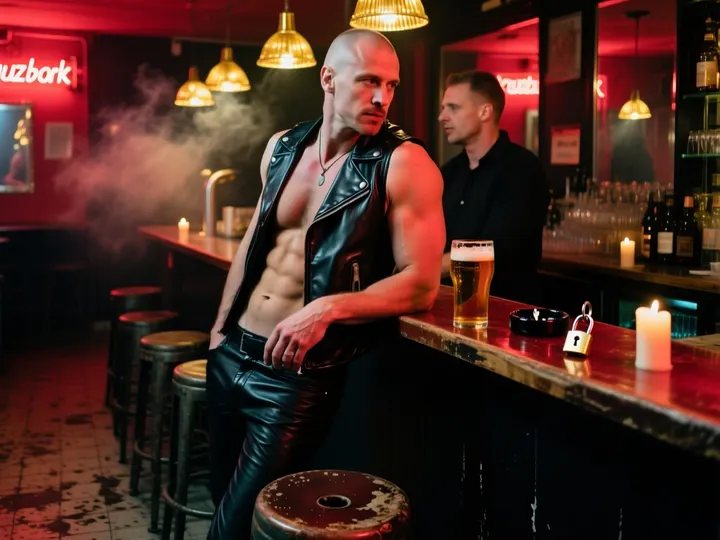
There is a charming, albeit naive, notion that once one steps out of the closet, one enters a Utopia of unconditional acceptance. We imagine the "Gay Community" as a monolithic sanctuary, a warm bath of solidarity where every variation of human desire is greeted with a nod of understanding. In reality, the community operates less like a family reunion and more like a high school cafeteria run by sociopaths with better skincare. It is a landscape of fractured tribes, rigid hierarchies, and a desperate, clawing need for validation. Within this ecosystem, the tension between belonging (finding a tribe) and authenticity (being one's weird, unvarnished self) is the central drama of our lives.
For the fortunate few, belonging is organic. They fit the mold. They are the "acceptable" gays—the ones who look good in a suit, who enjoy the correct music, and whose sexual proclivities are spicy enough to be interesting but vanilla enough not to frighten the horses. But for the others—the practitioners of the niche, the strange, the noisy, and the messy—the cost of admission to the tribe is often the amputation of the self. They are faced with a brutal choice: assimilate into the boring hegemony of the "Mainstream Gay," or commit to their specific freakery and risk the sneers of the very people who claim to be their brothers.
A 2023 study in the Journal of Social Psychology examined the concept of "minority stress" within LGBTQ+ subgroups. The findings were stark, if unsurprising to anyone who has ever worn a harness to a brunch: individuals who participate in "stigmatized" fetishes (such as pup play, age play, or medical kink) face a double burden. They navigate the homophobia of the straight world, only to turn around and face the "intraminority stress" of rejection from within the gay community itself (Katz & Morris, 2023). We are eating our own. The "cool kids" of the scene are replicating the bullying of the schoolyard, enforcing a normalcy that is suffocating the very diversity we claim to celebrate.
However, to attack the community as a whole is lazy. It is to commit the same sin of generalization that the bigots commit. Because within this mess, there are pockets of profound beauty. There are subcultures that function as genuine sanctuaries, where the "freaks" are not just tolerated, but exalted. The battle lines are not drawn between the Kinky and the Vanilla, but between the Authentic and the Performative. It is a war between those who do the thing because they love it, and those who judge the thing because they are terrified of themselves.
The Zen of the Good Boy
Let us look at the Pups. In the hierarchy of "cool," the Pups are often relegated to the bottom rung by the self-appointed arbiters of taste. The sneering Leatherman, clutching his beer and looking miserably stoic, views the barking, tail-wagging pack with disdain. "Look at them," his expression says, "making a mockery of our dignity." But if we strip away the cynicism and look at the reality, the Pups are often the happiest people in the room. While the critics are paralyzed by the fear of being "cringe," the Pups have transcended the ego entirely.
There is a profound courage in the decision to put on a hood and get on all fours. It is a rejection of the exhausting demands of human adulthood. The authentic Pup is not performing for an audience; he is accessing a headspace of pure, unadulterated play. He has found a "technology of the self"—to borrow from Foucault, though a Pup would likely just bark at him—that allows him to bypass social anxiety and access a state of flow. A recent anthropological analysis in Sexualities (2024) argued that the hood functions not as a concealment, but as a liberation device, allowing the wearer to drop the heavy armor of masculinity and access a vulnerability that is otherwise forbidden (Roberts & Vhane, 2024).
The "Good Pups"—the ones who are truly in the headspace—are untouchable. They have formed a pack structure that offers genuine loyalty and tactile affection, commodities that are increasingly rare in the cold, transactional world of Grindr hookups. They cuddle. They play. They protect each other. Contrast this with the "Judgmental Gay" standing in the corner, too cool to dance, too cool to smile, terrified that a hair might fall out of place. Who is truly free? The man worrying about his image, or the man chasing a squeaky toy with joyous abandon?
“The critic mocks the man in the dog mask because he is jealous. He is jealous of the freedom to be silly, the freedom to be soft, and the freedom to be happy without needing a permit from the Department of Cool.” — On the envy of the inhibited.
The problem arises not from the kink itself, but from the detractors who view "dignity" as a finite resource that the Pups are somehow squandering. These critics are usually the Assimilationists—the gays who desperately want to prove to the straight world that we are "normal." They throw the Pups under the bus to save their own respectability. But respectability is a trap. The Pups know this. They have chosen joy over dignity, and in doing so, they have achieved a kind of enlightenment that the stiff-necked critics will never understand.
The Guardians vs. The Mannequins
Now, consider the Leather scene. Here, the divide between the Authentic and the Performative is even sharper. The "Good Leathermen"—the Old Guard, the mentors, the ones who actually understand the history—are the custodians of a sacred tradition. For them, leather is not a costume; it is a discipline. It is about service, honor, and the heavy, tactile reality of the material. They understand that the authority of the Master is rooted in the care of the boy. They create spaces of immense safety where dark, dangerous things can be explored with surgical precision. They are the elders we should be listening to.
Then there are the "Mannequins." These are the men who have colonized the aesthetic of leather without doing the homework. They buy the harness because it looks good on Instagram. They go to the fetish bars not to engage in the culture, but to be seen engaging in the culture. They stand around looking intimidating, but if you scratch the surface, there is nothing there but a void and a gym membership. They are the ones who judge the Pups, the ones who judge the bodies that aren't perfect, the ones who treat the dungeon like a VIP section of a nightclub.
These Mannequins are the toxic element. They have gentrified the fetish. They want the look of the outlaw without the risk. They want the dominance without the responsibility. They are the reason why so many young men feel alienated from the scene. You walk into a bar, looking for connection, and you are met with a wall of judgmental silence from men who think that owning a Langlitz jacket makes them morally superior. It doesn't. It just makes them well-dressed cowards.
The authentic Leatherman, by contrast, is welcoming. He knows that everyone starts somewhere. He remembers his own first awkward steps. He does not sneer at the novice; he teaches him. He understands that the strength of the tribe comes from its cohesion, not its exclusivity. The Mannequin gatekeeps because he is insecure; the Guardian opens the gate because he is strong. We must learn to tell the difference, and to praise the latter while ignoring the former until they fade away into irrelevance.
The Loneliness of the Niche
For those in the truly niche corners—the rubberists, the medical players, the ones whose desires don't even have a flag yet—the struggle for belonging is a logistical nightmare. But it creates a bond that is diamond-hard. When you find the one other person in a hundred-mile radius who understands your specific language of desire, the connection is electric. These micro-communities are often the most supportive of all. They have to be. They have nowhere else to go.
The danger comes from the external judgment, the sneers of the "Vanilla Gays" or the "Mainstream Kinksters" (an oxymoron if there ever was one). These judges look at a rubberist sweating in a catsuit and say, "That's weird." They look at a diaper lover and say, "That's gross." This judgment is a projection of fear. The niche player holds up a mirror to the infinite complexity of human desire, and the average person is terrified by what they see. They want desire to be simple. They want it to be a straight line. The niche player proves it is a labyrinth.
We should celebrate the niche players as the explorers of the psyche. They are the astronauts of libido, going where few dare to tread. Instead of shaming them, we should be asking them for maps. The "good ones" in these communities are the ones who practice with consent, safety, and an open heart. They are building their own islands of belonging in a sea of conformity.
“Authenticity is a solitary pursuit, but belonging is a collective act. The miracle of the fetish scene is that it allows us to be solitary together. We can be alone in our specific madness, yet surrounded by people who will catch us if we fall.” — On the paradox of shared isolation.
The problem is never the kink. The problem is the hierarchy. The problem is the idea that some desires are "better" or "classier" than others. This is the lie we must dismantle. A harness is not superior to a diaper. A whip is not superior to a tail. They are just tools. The only thing that matters is the intent of the user. Is it used to connect, or is it used to exclude?
The Revolt of the Real
Ultimately, the gay fetish community is at a crossroads. We can continue down the path of gentrification, where we polish our edges, hide our weirdos, and present a sanitized version of kink to the world in hopes of being accepted. This is the path of the Mannequin and the Assimilationist. It is safe, it is marketable, and it is incredibly boring.
Or, we can choose the path of the Authentic. We can embrace the Pups, the freaks, the old-school Leathermen, and the latex-encased astronauts. We can realize that our strength lies not in our uniformity, but in our chaos. We can stop apologizing for being "too much" and start celebrating the fact that we are not "too little."
To the judgmental ones, the gatekeepers, and the bullies: you are fighting a losing battle. You are trying to hold back the tide of human variety with a velvet rope. It won't work. The weirdos are having more fun than you. They are finding a belonging that is deep and real, while you are stuck in the shallow end, worrying about your reflection.
To the authentic ones: keep barking, keep sweating, keep exploring. You are the beating heart of this community, even if the brain is too stupid to realize it. Belonging doesn't mean being like everyone else; it means finding the people who love you because you aren't. And in that search, the only compass you need is your own honest, unashamed desire.