The Carnival of the Approved
It is that time of year again when the streets of our metropolises are paved with glitter and good intentions. The corporate calendar has marked the month of June as the designated period for "Joy," a mandate enforced with the same rigor as tax collection. We are witnessing the annual migration of the Pride Parade, a spectacle that has evolved from a desperate, blood-soaked riot against police brutality into a synchronized marketing activation for multinational banks. The air is thick with the smell of cheap beer, expensive sunscreen, and the overpowering scent of moral self-congratulation. It is a festival of the absurd, where the very institutions that spent decades marginalized the "deviant" now fight for the privilege of printing their logo on a rainbow flag.
To observe a modern Pride parade is to observe the triumph of capitalism over radicalism. The float is no longer a platform for political demands; it is a moving billboard. We see defense contractors, whose products vaporize wedding parties in distant lands, marching under banners of "Love is Love." We see pharmaceutical giants, who price life-saving medication out of the reach of the poor, handing out branded condoms. It is a masterclass in cognitive dissonance. The message is clear: You are free to be whoever you want, as long as you have a credit score and a propensity to consume. The revolution has not just been televised; it has been franchised, packaged, and sold back to the oppressed at a markup.
There is a specific kind of obscenity in seeing the police force marching in uniform, dancing the Macarena, in the very spots where they once cracked skulls. It is a rewriting of history so brazen it would make a Stalinist censor blush. The parade demands amnesia. It asks us to forget that rights were not given by benevolent states or enlightened corporations; they were taken by people who had nothing left to lose. By turning the commemoration of a riot into a family-friendly street party, we have successfully neutered the beast. We have turned the wolf into a poodle, dyed it pink, and taught it to jump through hoops for a corporate treat.
A 2023 analysis by Data for Progress revealed that many of the corporations sponsoring Pride festivals in the United States and Europe simultaneously donated millions to politicians actively working to roll back LGBTQ+ rights (Data for Progress, Corporate Pride vs. Political Action, 2023). This is not an accident; it is a hedging of bets. The corporation supports the gay market because the gay market has disposable income. It supports the conservative politician because the conservative politician lowers taxes. The Pride parade is merely the public relations arm of this cynical equation. It is a rainbow-colored smoke screen designed to obscure the fact that the only color that truly matters to the organizers is green.
The attendees, largely well-meaning and intoxicated, seem oblivious to this. They cheer for the bank that foreclosed on their neighbor’s house because the bank’s employees are wearing matching t-shirts. It is a mass suspension of critical faculties. The demand for "visibility" has been met, but the cost was the soul of the movement. We are visible, certainly. We are visible on every ATM screen and sandwich wrapper. But one must ask: is this liberation, or is it just product placement?
The Smugness of the "Post-Gay" Bourgeoisie
If the spectacle of the parade is nauseating in its commercialism, the reaction of a certain subset of the gay community is equally insufferable in its arrogance. I speak of the "Assimilationist," the "Post-Gay," the man who sits in his tastefully decorated apartment and sneers, "I don't need a parade to validate my existence. I am just a normal person. Why do they have to make such a scene?" This is the voice of the privileged amnesiac. It is the voice of someone who believes that because they can get married and buy a Dyson vacuum cleaner without harassment, the war is over.
These critics view Pride as an embarrassment. They cringe at the drag queens, the leather daddies, and the naked bodies. They desperately want to be seen as "respectable." They have internalized the homophobia of the oppressor so thoroughly that they now police their own community with more vigor than the church ever did. Their argument is usually, "We want to show the world we are just like them." This is a tragic ambition. To aspire to be "just like" the heterosexual majority—a demographic historically defined by its capacity for boredom, divorce, and bad architecture—is a low bar indeed.
The "I don't make it my whole personality" crowd fails to realize that their ability to live a quiet, integrated life is a luxury purchased by the very people they despise. The "freaks" on the floats—the trans women, the dykes on bikes, the radicals—were the ones who threw the bricks. The assimilationist enjoys the shade of a tree they did not plant and complains that the leaves are too loud. It is a display of ingratitude that borders on the pathological. They believe their safety is a permanent state of affairs, guaranteed by their own personal excellence and adherence to social norms. This is a delusion.
“The conservative gay man believes that if he wears a suit, pays his taxes, and keeps his sexual deviations strictly private, the leopard will not eat his face. He is always surprised to find that the leopard has no interest in his tailoring, only in his blood.” — On the futility of respectability politics.
The "unnecessary" argument crumbles the moment one looks at a map. According to the ILGA-Europe Annual Review 2024, there has been a significant regression in legal protections and a sharp rise in hate speech across the continent, even in countries previously considered "safe" (ILGA-Europe, 2024). The assimilationist ignores this. They mistake their bubble for the world. They mistake their brunch for geopolitics. To claim that Pride is unnecessary because you personally feel safe is the height of solipsism. It is to say, "I have eaten, therefore hunger has been solved."
Furthermore, this attitude reveals a deep-seated fear. The gay man who hates Pride hates it because it reminds him of his difference. He has spent his life trying to scrub away the stain of the "other," to blend in, to pass. The parade, with its excess and its refusal to apologize, acts as a mirror he does not want to look into. It reminds him that no matter how many polo shirts he buys, he is still, in the eyes of the true establishment, a deviation. His disdain is not intellectual; it is a defense mechanism. He is terrified that the glitter might rub off on him and ruin his camouflage.
The Aesthetic of Sanitized Rebellion
Let us return to the event itself, which manages to displease both the radical and the conservative for different reasons. The aesthetic of modern Pride is a fascinating study in the sterilization of sex. It is a paradox: it is an event centered on sexuality that has been stripped of all eroticism. We see bodies, yes. We see muscles, speedos, and harnesses. But it is presented with the sexless cheerfulness of a fitness infomercial. It is "Family Friendly" fetishism.
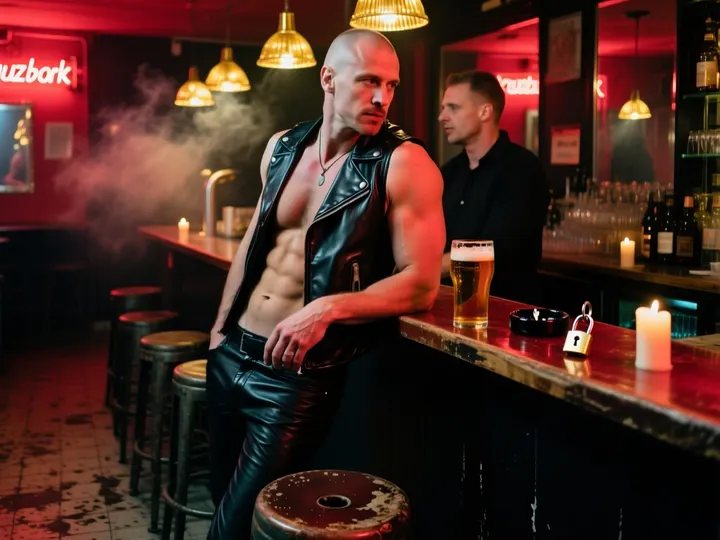
The organizers are obsessed with "acceptability." They want the sponsorship money, so the kink must be kept within "reasonable" limits. The result is a weirdly neutered display where the visual language of S&M—the leather, the chains, the masks—is reduced to a costume. It is no longer about power exchange or pain; it is about looking edgy for Instagram. The danger has been removed. A leather harness worn to a corporate-sponsored parade is no longer a symbol of sexual outlawry; it is just an accessory, like a watch or a scarf.
This sanitization serves a dual purpose. It makes the event palatable to the straight tourists who come to gawk at the animals, and it reassures the corporate sponsors that nothing "untoward" will happen near their logo. It is the Disneyfication of the queer experience. We are allowed to be gay, but only in a way that is colorful, happy, and non-threatening. We must be the "fun" minorities. We must provide the soundtrack and the decor. The moment the anger returns, the moment the demand for justice supersedes the demand for a party, the sponsors will flee like rats from a sinking ship.
The irony is that the critics who claim Pride is "too sexual" are missing the point. It is not sexual enough. It is pornographic in the Baudrillardian sense—it is the hyper-real simulation of sex without the messy reality of human connection. It is plastic. Real sexuality is private, dark, complicated, and often quiet. Pride is public, bright, simple, and deafening. It replaces the intimacy of the subculture with the broad strokes of the caricature.
The Ritual of Mutual Contempt
So we are left with a stalemate. On one side, the Pride-goers, marching in their corporate t-shirts, convinced they are changing the world by drinking vodka in the street. On the other side, the cynicism of the "Post-Gay" elite, convinced they are superior because they stay home. Both are engaged in a form of delusion.
The Pride-goer believes that visibility equals power. They believe that if we just wave the flag hard enough, the laws will not change back. They ignore history, which teaches that progress is fragile and reversible. They are partying on the edge of a precipice, mistaking the vertigo for euphoria.
The critic believes that apathy equals sophistication. They believe that disengaging from the "scene" makes them independent thinkers. In reality, it just makes them isolated and vulnerable. They are the free-riders of the civil rights movement, benefiting from the sweat of others while mocking the smell.
“We are trapped between a circus that has lost its meaning and a spectator class that has lost its memory. The parade continues not because it achieves anything, but because the silence that would follow if it stopped is too terrifying to contemplate.” — On the persistence of hollow rituals.
Perhaps this is the ultimate function of Pride in the modern era. It is not a protest, nor is it a celebration. It is a stress test. It brings the fissures in the community to the surface. It forces us to look at the unholy alliance between capital and identity. It forces us to confront the class divide between the gay elite and the queer marginalized. And it forces us to endure the unbearable noise of forced happiness.
The parade will happen again next year. The banks will print new banners. The politicians will learn new slogans. The critics will write new tweets about how much they hate it. And the world will continue to turn, indifferent to the color of the flag we drape over its misery. It is a perfect, self-sustaining ecosystem of nonsense. And in that sense, it is the most human thing we do.